
Elon Musk vs. the Global Deep State:
Why the World’s Most Important Technologist Became Their Primary Target
There is a familiar pattern in modern politics: When an outsider threatens centralized power, the system mobilizes to destroy him.
I’ve said this many times over the years, and it’s never truer than today - the aristocracy will protect itself before any particular person, political party, or even ideology.
It happened to Donald Trump. He was a democrat and media darling for decades. He was universally loved by these people until he represented a threat to their power. And now, the same is happening to Elon Musk—this time, at a global scale.
Musk’s companies transformed American transportation, revitalized space exploration, strengthened national security, and—most dangerously for the ruling class—he cracked open the censorship regime that governed online speech for a decade.
For that, every entrenched institution—from Washington bureaucrats to EU regulators to foreign intelligence-linked bot farms—has turned their guns on him. Most of us know now how the Biden Administration targeted Musk, in addition to leftists throughout the US, and we know that the EU has pursued lawfare against him as well.
What you may not know of is the intense foreign bot armies engaged in a massive information operation to bring chaos, hate, and polarization in American politics, largely driven by astroturfing reactionaries and extremists like Nick Fuentes.
The NCRI (National Contagion Research Institute) has published a landmark study on precisely how these bot farms operate, how they astroturf bad ideas, and how the media is complicit.
DataRepublican on X and Substack has published a thorough breakdown of this study, which you can find right here.
In this article, we will discuss astroturfing as part of a larger attack against Elon Musk and the United States, and how the leftists in America and the EU want to shut him down.
This is not paranoia. It is observable, documented, and now quantifiable.
The Moment Elon Musk Became a Threat
Before he bought Twitter, Musk like pre-POTUS Trump enjoyed near-universal praise. He was the future. The genius. The innovator. Hollywood and Silicon Valley loved him. Then he bought the one platform the ruling class needed to control. What followed was a level of insanity on par with Trump Derangement Syndrome.
Lunatics began defacing and vandalizing Teslas, despite the vehicles having cameras. Tesla ownership fell from 40% Democrat to just 27% in less than three years. He was stalked, he was called a nazi, and that was only the beginning. So why would Musk, a previously apolitical businessman even involve himself?
His explanation for doing so was not financial—but civilizational:
“I didn’t do the Twitter purchase because I thought it was a great way to make money. I knew that there would be a zillion slings & arrows coming in my direction.
It really felt like, there was a civilizational danger that unless one of the major online platforms broke ranks… Literally there was no place to actually get the truth.
Everything was just getting censored. The power of the censorship apparatus was incredible.”
This statement alone explains the war that followed. Musk didn’t expose just the Twitter Files. He exposed the existence of the censorship-industrial complex. He broke ranks, and for a system built on information control, that is unforgivable.
The Biden Administration’s Political Offensive
Once Musk opened the censorship vault, the U.S. government responded predictably:
Leaked DHS/NGO reports labeled X a “threat to democracy.”
Federal agencies launched investigations into Tesla and SpaceX.
The White House pressured advertisers to boycott X.
Intelligence-linked nonprofits began smearing Musk as a “radicalizing force.”
The message was clear:
You restored free speech that upsets our controlled narrative. Now you must pay.
It is an unbelievable escalation that a sitting administration would cajole Americans to boycott an American company for political reasons when that company’s chief competitors are foreign, such as China’s BYD, Xiaomi and Nio and European/Korean automakers Hyundai, Kia, VW and BMW.
America last.
This is the same playbook used against Trump—weaponize institutions against anyone who threatens the administrative state’s monopoly on narrative power.
The European Union Joins the Fight
The attacks from the U.S. were only the first wave. Then the European Union escalated dramatically.
The EU fined X €120 million (~$140 million) for refusing to censor according to Brussels’ political standards.
The official charge:
“Deceptive” blue checkmarks
Inadequate “content moderation”
Insufficient censorship algorithm transparency
The real issue: Musk wouldn’t silence people they wanted silenced.
Then came the most explosive claim:
Musk revealed EU officials offered him an illegal secret deal
—essentially a bribe to quietly censor political content in exchange for escaping fines.
He refused, of course, so they escalated. He cut off the European Commission’s advertising account in retaliation. This is not a regulatory dispute. This is a geopolitical battle over who controls public speech.
As of this writing, December 8, 2025, X is the number 1 news platform in the EU.
A New Front Opens: Foreign Bot Farms Target X
While Western governments attack Musk for not censoring enough, foreign adversaries attack his platform for the opposite reason: because X enables truth to spread without ideological filters.
The NCRI’s new publication, America Last: How Fuentes’s Coordinated Raids and Foreign Fake-Speech Networks Inflate His Influence—reveals a stunning level of foreign manipulation occurring on X, targeting American political discourse with antisemitic and anti-American propaganda.
Key findings include:
1. Fuentes’s early retweet velocity outpaced even Elon Musk’s
Despite <1% of Musk’s following, Fuentes achieved faster early engagement than the platform’s most-followed user.
Figure 1A (p. 7):
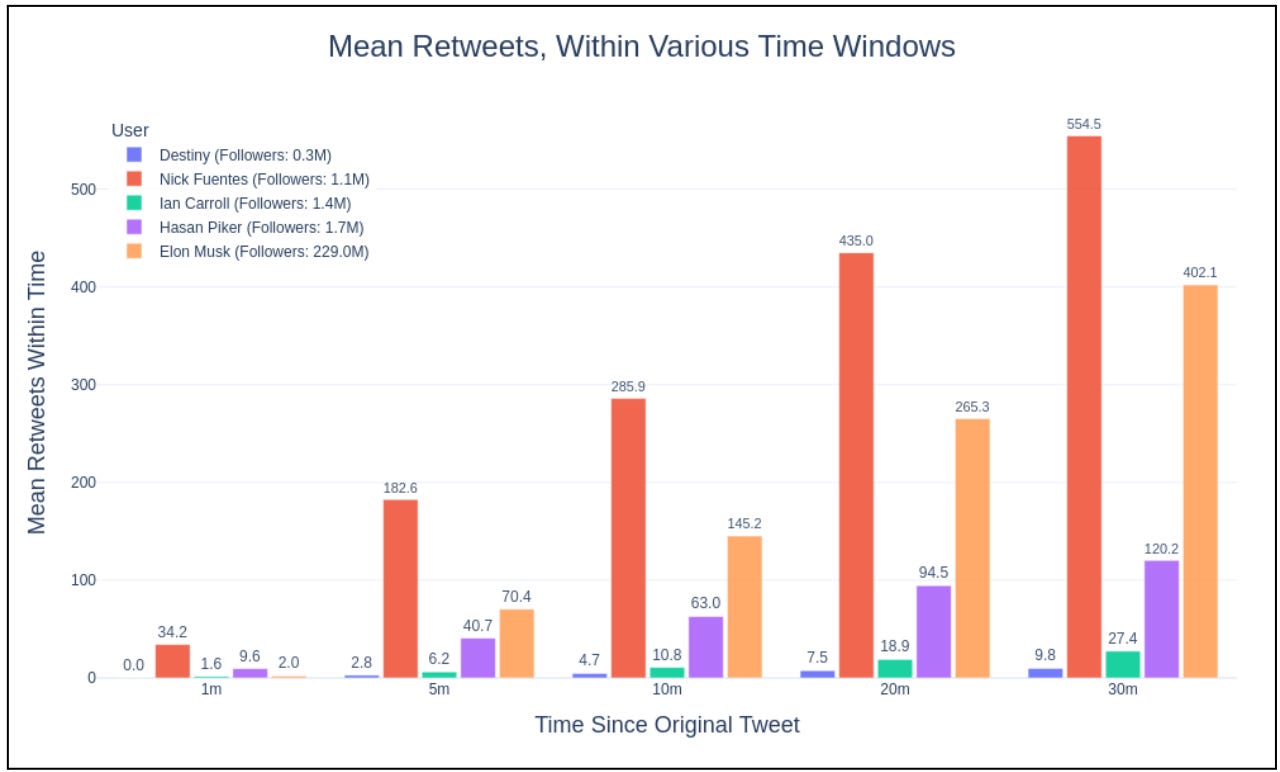
This is impossible organically.
It signals algorithmic manipulation.
2. 61% of Fuentes’s early retweets came from repeat accounts
Meaning a coordinated group was retweeting him instantly, repeatedly.
Figure 2 (p. 9):
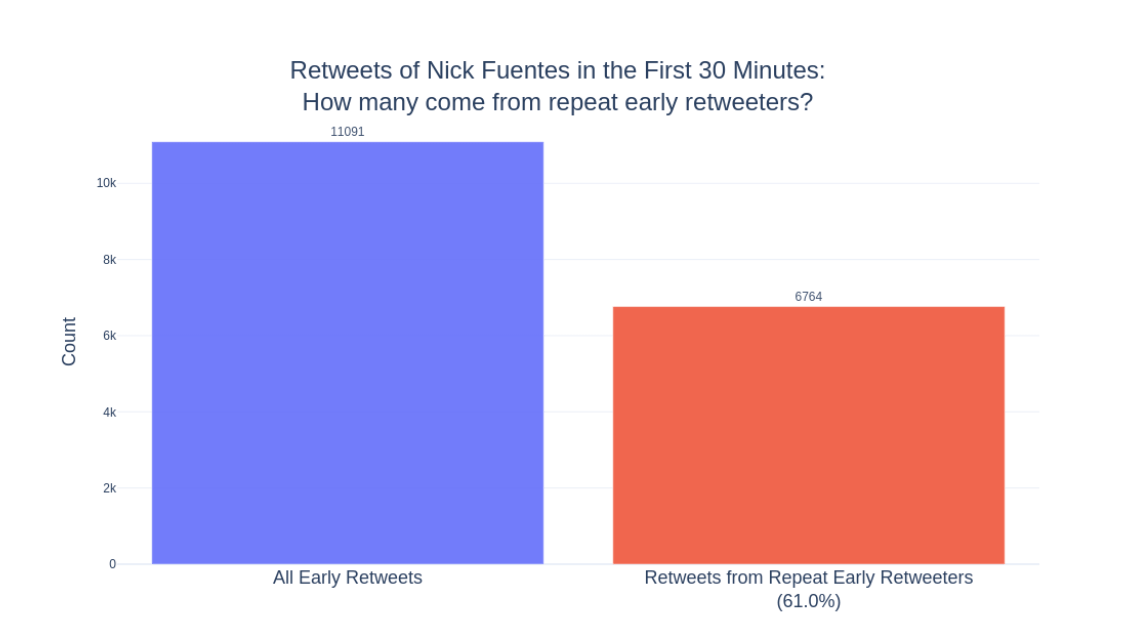
These are not fans. They are bot assets behaving like a military unit on behalf of foreign governments (more on that).
3. 92% of his amplification accounts are anonymous
Figure 3 (p. 9):
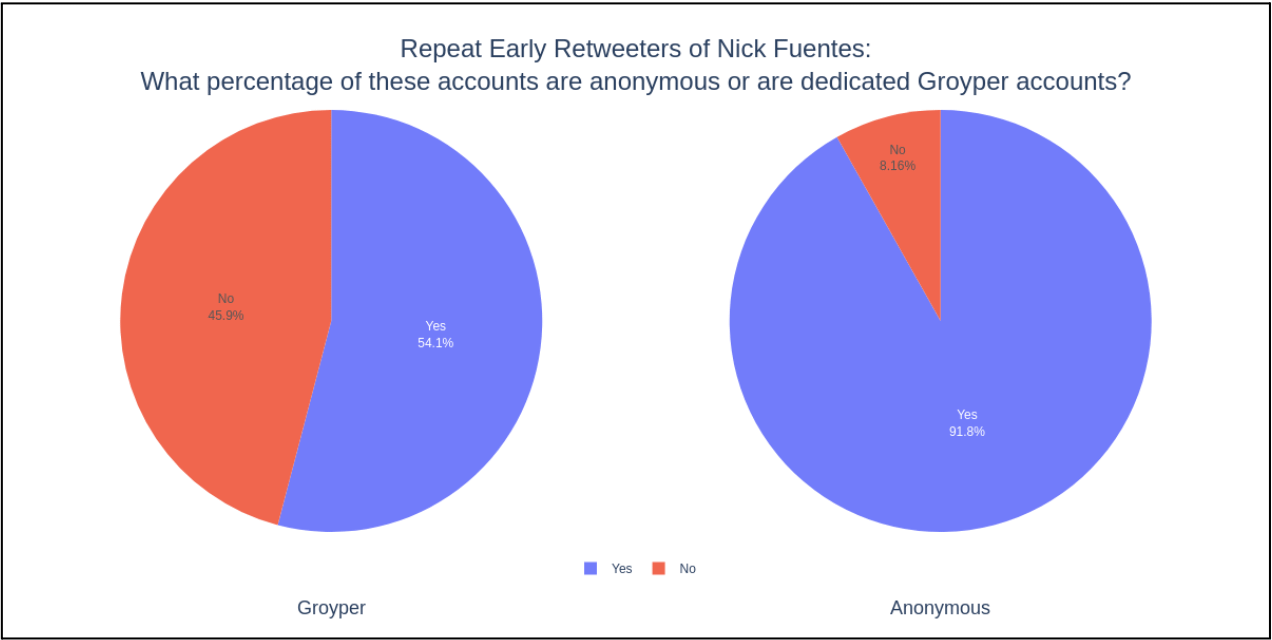
Most use Pepe imagery, crusader symbols, or “America First” flags—low-cost sock-puppet accounts from countries with cheap labor and high click-farm activity.
4. Foreign bot-farm regions dominate Fuentes’s viral amplification
And now we get to the who. A cursory analysis of this traffic shows it is inorganic, but who is launching these astroturfing attacks? The short answer - NOT AMERICANS.
“Before [Charlie] Kirk’s assassination, the foreign retweet pool also showed a highly irregular geographic footprint. Although the top 2 foreign sources were the UK (12%) and Canada (9%), non-Western countries together constituted the source of a majority of the foreign retweets of Nick Fuentes (Appendix 2, Table A). The top non-Western sources of Fuentes retweets included India (7%), Pakistan (7%), Nigeria (4%), Malaysia (3%), and Indonesia (3%).
There is no organic explanation for this pattern. There is no natural ideological or cultural link between these regions and a fringe American extremist figure, especially one whose content is tightly focused on US politics and who espouses white supremacy.”
Appendix 2, Table A:
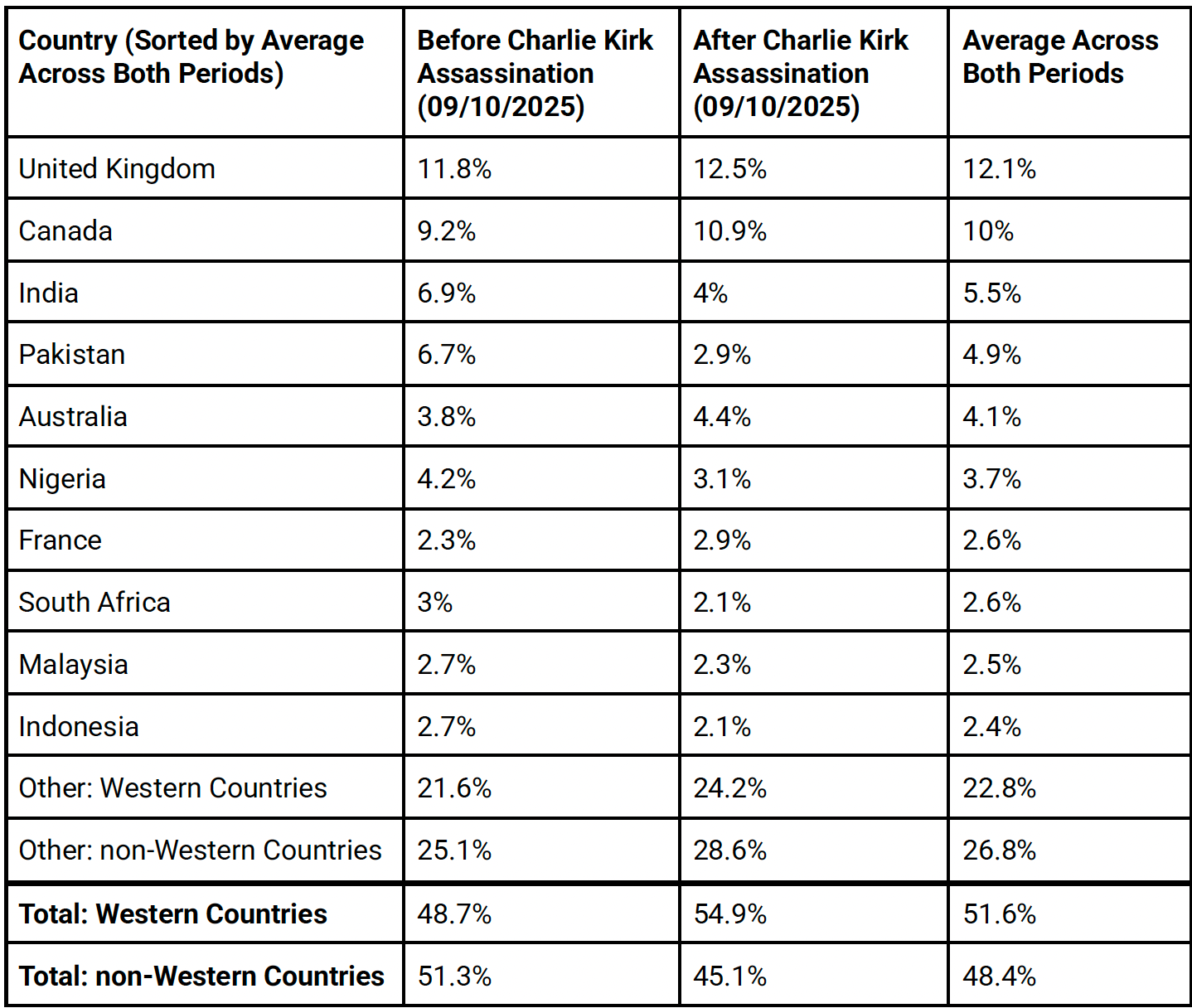
These regions match known bot-farm hubs used by Russia, China, Iran, and proxy cyber-operators. The report describes this as “highly irregular… consistent with outsourced engagement infrastructure.”
Why Does This Matter for Elon Musk?
Despite purchasing and revamping X as a means of fighting censorship, it’s still a business and one that sells advertising based on user interactions. As such, Musk is the victim of these foreign bot armies just like the American discourse is, as they pollute his advertising environment.
Instead of working with him to solve these issues, the US government under Biden and the EU have persecuted him while doing nothing to assist in identifying and prosecuting foreign adversaries who are both poisoning our national discourse and victimizing an American company.
For his part, Musk has built transparency tools—like “About this Account” and country-of-origin detection—that exposed these foreign influence operations. He broke the information laundering cycle:
foreign bot farms → manipulated engagement → U.S. media misreads the signal → extremist narratives enter mainstream coverage.
In other words: He exposed how the information war is actually fought. An information war that the intelligence community under Biden ignored, and one the EU continues to ignore.
The NCRI report explicitly shows:
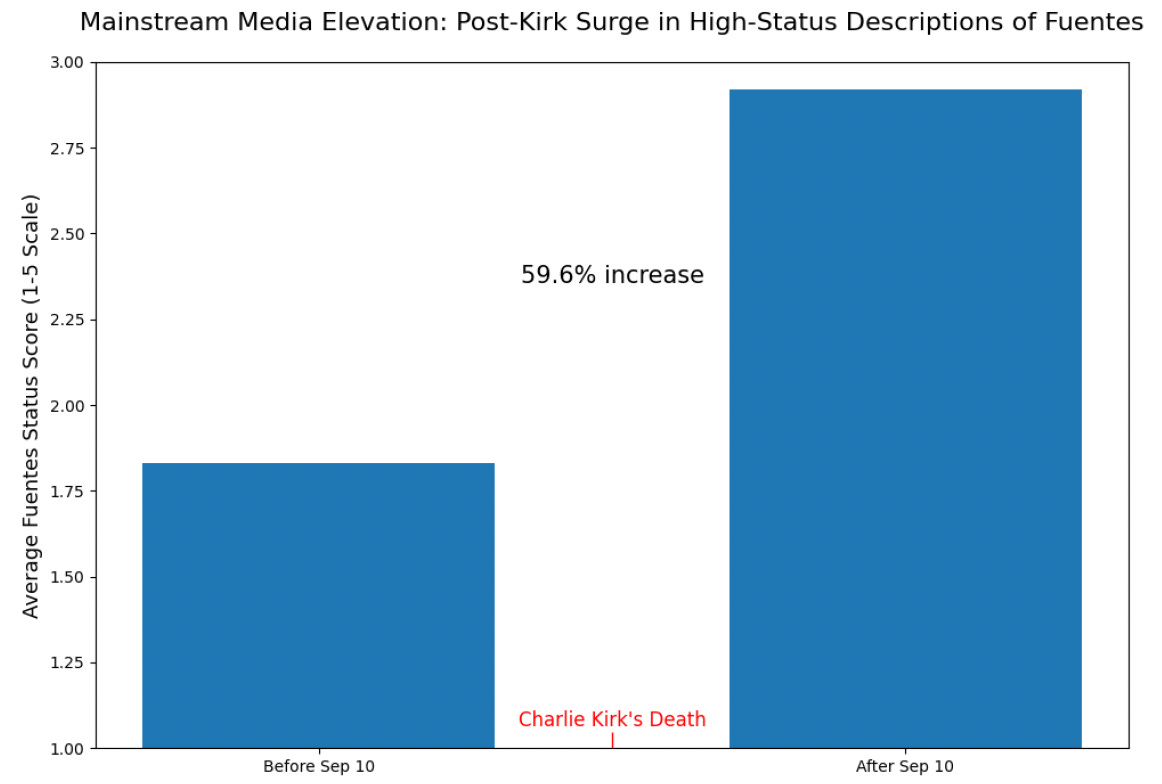
Media coverage of Fuentes tripled after manipulated spikes
High-status portrayal increased 59.6%
Bot-driven virality shaped national discourse
Foreign actors exploited X to inflame division in America
The US Mainstream/Legacy media is amplifying this anti-American messaging
Figure 8 (p. 15–16):
Any honest observer can clearly see this is an information operation being conducted against the people of the United States. Who benefits from this? Not Musk. Not the American people. But foreign adversaries seeking chaos—and domestic political factions who weaponize extremism to justify new censorship powers.
Why Musk Is the Target—and Why the Deep State Fears Him
The campaign against Elon Musk and the American political discourse is not random, reactive, or organic. It mirrors the pattern used against every outsider who threatens entrenched power.
The moment Musk bought Twitter and dismantled the censorship machinery, the attacks began to converge: federal agencies launched investigations into Tesla and SpaceX; the Biden administration publicly pressured advertisers to abandon X; the EU fined him hundreds of millions and allegedly attempted to bribe him into secret censorship compliance; foreign adversaries unleashed bot networks to flood his platform with synthetic chaos; and legacy media pivoted from praising him as an innovator to portraying him as a destabilizing villain. He was targeted legally, financially, politically, and informationally—because he disrupted the architecture of control.
Musk is a threat to the deep state for a simple reason: he broke their monopoly on information. For a decade, the censorship regime operated quietly across Silicon Valley platforms, federal agencies, intelligence-linked NGOs, and legacy media outlets. It was a distributed system with a singular purpose—shape the narrative by restricting what the public is allowed to say, see, or question. Musk revealed its existence, exposed its internal communications, and refused to enforce its demands. The deep state depends on managing perception, and Musk dismantled the enforcement platform they relied on. That alone made him an existential problem.
He is a threat to globalist institutions, particularly the European Union, because he represents a model of sovereignty they cannot control. Brussels cannot dictate Starlink policy. It cannot regulate SpaceX launches. It cannot force Tesla to subordinate engineering priorities to ideological ones. And it cannot compel X to adopt EU-approved censorship frameworks so long as Musk refuses.
Globalist regimes function by aligning corporate, political, and media institutions into a single harmonized system—what Musk disrupted was not just their preferred speech rules, but their worldview: that unelected bureaucracies, not citizens, should decide what is true. Musk inverted that power relationship, returning the right of interpretation to the public.
Musk further threatens all centralized power because he is independent in a way modern elites cannot tolerate. He cannot be bought, controlled, or socially coerced. His wealth makes him immune to financial pressure. His platforms make him immune to media isolation. His innovations make him immune to political retaliation; the U.S. government needs SpaceX more than SpaceX needs the U.S. government.
And his ideology—rooted not in technocratic paternalism but in classical American liberty—makes him unpredictable to a system that depends on predictable compliance. A man who believes in free speech, who exposes foreign manipulation, who strengthens American strategic infrastructure, and who empowers individuals over institutions is a direct challenge to the managerial class that governs through narrative, not consent.
That is why Musk became a global target. Not because of political commentary. Not because of ideology. But because he disabled the mechanisms that powerful institutions—foreign and domestic—require to maintain control. He restored free speech at enormous personal cost. He rebuilt America’s space dominance. He strengthened national communications resilience. And he returned the public square to the public. Musk didn’t just buy a social platform; he acquired one to create the last uncensored arena of civic life. For the deep state and globalist order, that is intolerable. For anyone who still believes in liberty, it is indispensable.