
One Man With Courage
He was forty-four years old, and he looked sixty.
George Washington sat his horse on the Pennsylvania shore of the Delaware in the blackest hour of Christmas night, 1776, cloak frozen stiff, face carved by wind and worry. The man who had once surveyed wilderness for British lords now surveyed ruin: an army that had been twenty-five thousand strong in July was down to fewer than three thousand half-naked, half-starved scarecrows. Smallpox, desertion, and defeat had done their work. New York was lost. New Jersey was lost. Philadelphia would fall within weeks. Congress had fled like frightened geese.
The Revolution was bleeding out.
And yet here he stood, risking everything (his reputation, his fortune, his life) on a throw of the dice so desperate that sane men called it madness.
The Man
Washington had never been a prodigy. No Mozart of war. He had blundered spectacularly in the French and Indian War (Jumonville Glen, Fort Necessity), had worn a British uniform without ever rising above colonel, had lost more battles than most generals ever fight. What he possessed was not brilliance but something rarer: a granite refusal to quit when quitting was the rational choice. He had learned restraint the hard way (standing tall at Braddock’s defeat while bullets tore the coat off his back), learned patience holding the Virginia line together with spit and prayer, learned that men will follow a leader who will not lie to them and will not leave them.
He was tall, almost inhumanly tall in the saddle, with hands big enough to crack walnuts and eyes that made lesser men look away first. He rarely smiled in public, never swore, and could silence a room simply by entering it. Thomas Jefferson said he was the only man in whose presence he ever felt small. Yet he had no taste for crowns; when a colonel named Lewis Nicola suggested in 1782 that America needed a king, Washington crushed the idea so hard the man nearly lost his commission.
Tonight, he needed every ounce of that authority, because he was asking men who had not been paid in months, who had not eaten meat in weeks, whose barefoot marching left blood in the snow, to climb into boats and cross an ice-choked river in a snow storm so they could attack professional soldiers at dawn. All that failure did not dissuade him, but rather led him to this moment where his country needed him. There was no one else.
The War to That Point
The year had been a litany of disasters.
Boston won, yes, but then the Continental Army sailed south to defend New York and walked into a slaughter. Howe’s redcoats and Hessian mercenaries drove them across Long Island, across Manhattan, across the Hudson, across New Jersey like a broom sweeping dirt. Fort Washington fell. Fort Lee fell. Men surrendered by the thousands because surrender meant food and warmth. The British issued pardons to anyone who would swear loyalty; thousands took them. Thomas Paine, riding with the retreat, wrote that these were “the times that try men’s souls.”
By December the cause looked dead. Britain controlled every major port. Congress had given Washington near-dictatorial powers out of sheer panic. He had one card left, and he was about to play it.
The Crossing
The plan was simple on paper, insane in practice. March nine miles to McKonkey’s Ferry after dark. Cross the Delaware with 2,400 men, eighteen cannons, and fifty horses. Land on the Jersey side before dawn. March another nine miles through a storm to Trenton, where 1,400 Hessians under Colonel Johann Rall celebrated Christmas the German way (plenty of schnapps, no sentries worth mentioning). Hit them at first light. Win or die.
The storm arrived early. Sleet first, then snow, then chunks of ice the size of dinner plates riding a flood tide. The river ran savage, black water hurling tree trunks and ice floes like battering rams. Durham boats (long, narrow iron ore barges) pitched and groaned. Men who had never seen the ocean retched over the gunnels.
Washington was everywhere. He stood at the bow of the lead boat, cloak snapping like a flag, one boot on the thwart, steadying the tiller with a hand the size of a ham. Ice coated his eyelashes. His horse, Nelson (yes, he had a horse named Nelson), shivered on the next boat, eyes rolling white. Marbleheaders (Glover’s Massachusetts fishermen) worked the oars and poles while cursing the weather harshly enough to make a pirate blush. Henry Knox, the fat Boston bookseller turned artillery genius, bellowed encouragement while cannons threatened to smash through the hulls.
The crossing that was supposed to take three hours took nine. Many regiments never made it across at all. By the time the last man staggered ashore, it was four in the morning and the temperature had fallen below twenty degrees. Feet were frozen inside boots. Muskets were iced shut. Half the army had no coats. The less fortunate had no shoes.
Washington looked at his watch, looked at the sky, and said quietly, “Press on.”
The March
Nine miles to Trenton.
The road was a sheet of ice. Men slipped, fell, and rose bleeding. Two soldiers froze to death on the march and were left where they fell. Washington rode up and down the column, voice hoarse but steady: “For God’s sake, keep with your officers.”
At Bear Tavern he halted the army just long enough for each man to chew a mouthful of wet hardtack and swallow a quarter pint of rum. Then they formed into two columns: one under Nathanael Greene (the Rhode Island Quaker turned fighting general), the other under John Sullivan (the hot-tempered New Hampshire lawyer). Washington rode with Greene.
The storm grew worse. Wind screamed through the pines. Snow blinded them. You could not see the man in front of you. Only the crunch of frozen boots and the creak of cannon wheels told you the army still moved.
The Battle
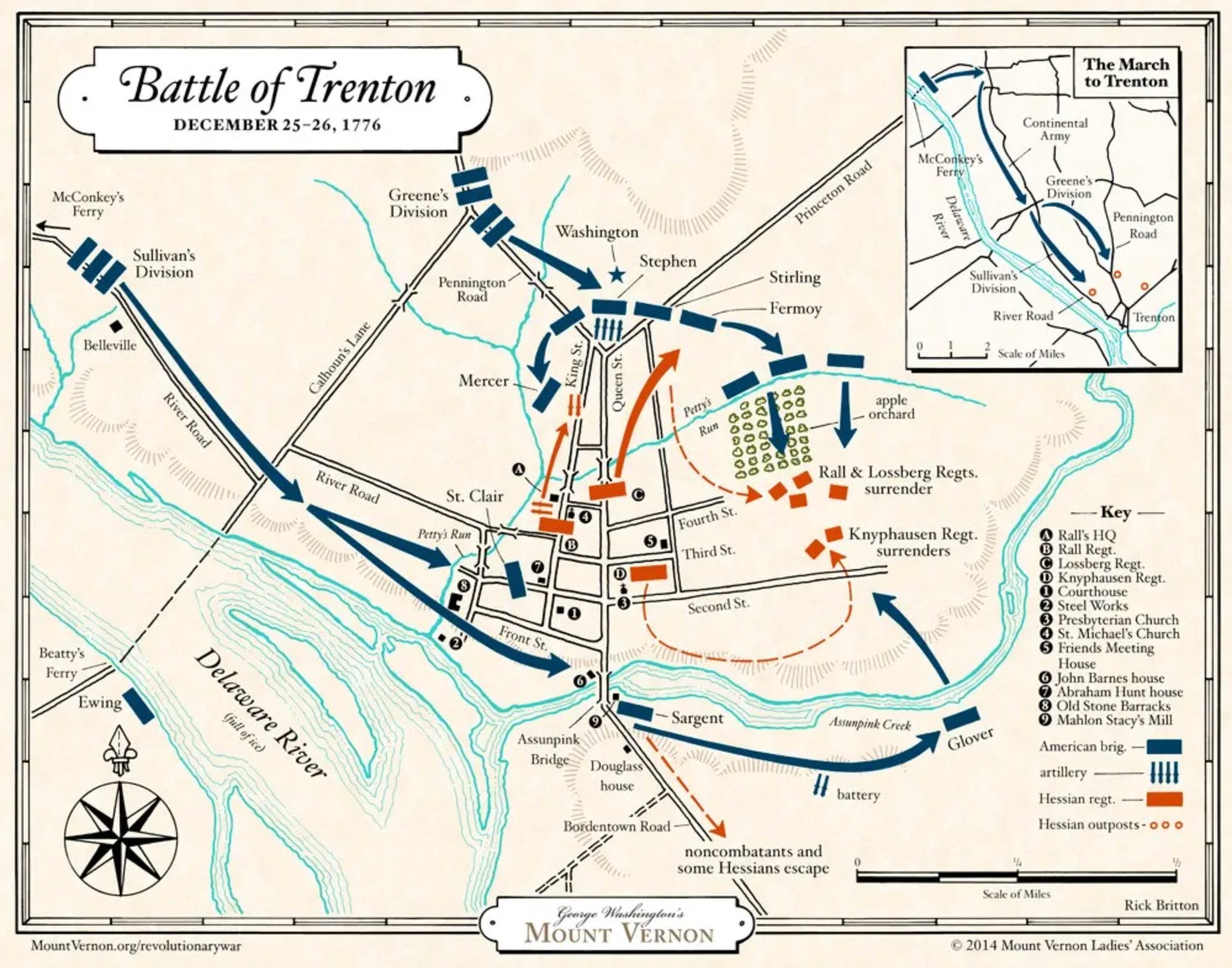
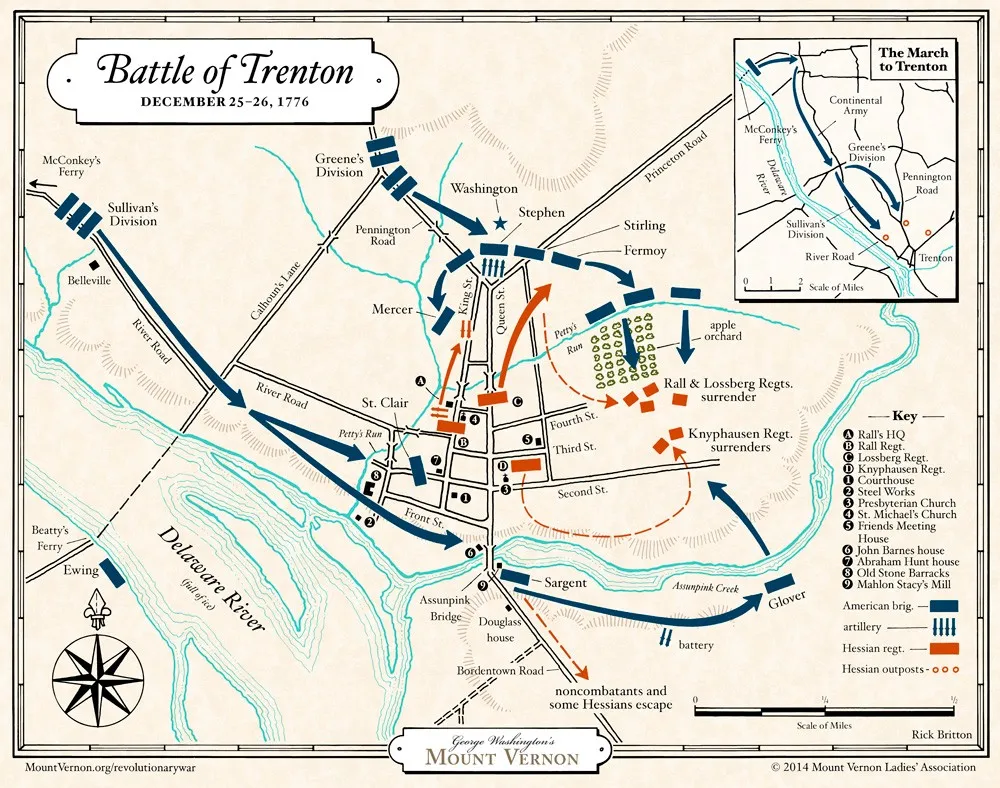
They hit Trenton at eight o’clock, two hours late but unseen. The Hessians were still drunk and asleep. Rall himself was dragged from his bed in shirtsleeves, face red with wine and shock.
The Americans came out of the white like ghosts.
Knox’s guns opened first (eighteen cannon roaring from the head of King and Queen Streets). Then the infantry: Virginia rifles, Massachusetts bayonets, Pennsylvania muskets. The storm swallowed the sound of individual shots and belched back only a continuous rolling thunder.
The Hessians tried to form in the streets. Too late.
American infantry poured fire from windows and alleys. Knox’s guns swept the streets with cannon fire. Hessian artillery horses were cut down in their tracks. Men slipped on icy cobblestones and died before they could rise.
Washington stood in the middle of it all on his white charger, cloak thrown back, hat gone, hair powdered with snow. Cannonballs screamed past him. He never flinched. A captain begged him to take cover. Washington looked down as if the man were speaking a foreign language and calmly remarked, “No. This is our day.”
Rall tried to rally his brigade on the edge of town. He took two bullets (one in the side, one mortal). The Hessian line broke. Men threw down muskets and raised white handkerchiefs. In forty-five minutes it was over.
Twenty-two Hessians dead. Eighty-three wounded. Nearly a thousand prisoners. American losses: two frozen on the march, four wounded in the fight. Not a single man killed in battle.
The Aftermath
They took everything: cannons, muskets, powder, rum, the regimental colors, even the Hessians’ drums. Then they marched the prisoners back across the river before British reinforcements could arrive.
Ten days later Washington did it again (crossed the same river, fought at Princeton, saved the Revolution for another season). But Trenton was the night the music changed.
Volunteers began to trickle back. Congress found its nerve. France began to believe this ragged army might actually win. The idea that ordinary men could beat the finest professionals in Europe went from fantasy to fact in one frozen dawn.Washington never bragged about it.
He wrote Congress a short note: “Providence has favored us.” He knew better.
Providence had favored them because one man refused to let the river, the ice, the storm, or even his own failure itself have the last word.
That man rode back across the Delaware at noon on December 26, soaked, half-frozen, exhausted beyond measuring, and for the first time in six months he allowed himself the ghost of a smile.
America learned a lesson that day, one that would later be captured by President Andrew Jackson:
One man with courage makes a majority.
Psychology is contagious. Washington knew it. And because he did, the Revolution had a pulse again and we sit here today, on Christmas, in the greatest country in the history of the world.
Merry Christmas.
Awesome! Merry Christmas
Love this, thanks Dan. Merry Christmas to you and your family brother